How do you start practising Kabbalah Meditation?
Kabbalah meditation starts small: a few minutes of steady breath, one Hebrew letter or one point on the Tree of Life held in your attention. That is enough to begin. Kabbalistic meditation techniques range from silent contemplation to the quiet chanting of divine names, and Kabbalah meditation for beginners works best when you choose one of them and repeat it daily. At Holistic Psychology Practice in Den Haag I teach it as a practical discipline . never as a belief system. If you want the wider picture first, we describe it in our guide to soul-centered guidance via the Tree of Life. Below, we walk you through what the practice is, how to start, and where a guide makes a real difference.
It is the contemplative side of Jewish mysticism. You rest your attention on the Tree of Life, a Hebrew letter, a divine name or the breath, and let the busy mind settle into stillness and insight. Unlike general mindfulness, it works with a symbolic map.
Mindfulness asks you to watch whatever arises. Kabbalistic practice gives your attention a shape. You are not only observing, you are walking through a structure that has been refined for centuries, and that changes how a sitting feels.
The contemplative current is quiet. You reflect on a sefirah, a letter or a name, and stay with it. The ecstatic current is older and more intense. In the thirteenth century Abraham Abulafia taught combining letters with breath and sound to reach heightened states, and that is not where we send a newcomer.
Start contemplative. The ecstatic methods are powerful, and they are far safer next to someone who knows how to bring you back down.
Hitbodeduth means a deliberate time of solitude. You sit alone, in silence or in quiet inner speech, and let attention turn inward. Merkavah is an early visionary tradition built on Ezekiel's vision of the chariot, with an inner ascent through imagined stages. Both are roots of the practice, not first steps.
Three tools carry most of the practice. You can use them alone or braid them together once each feels familiar.
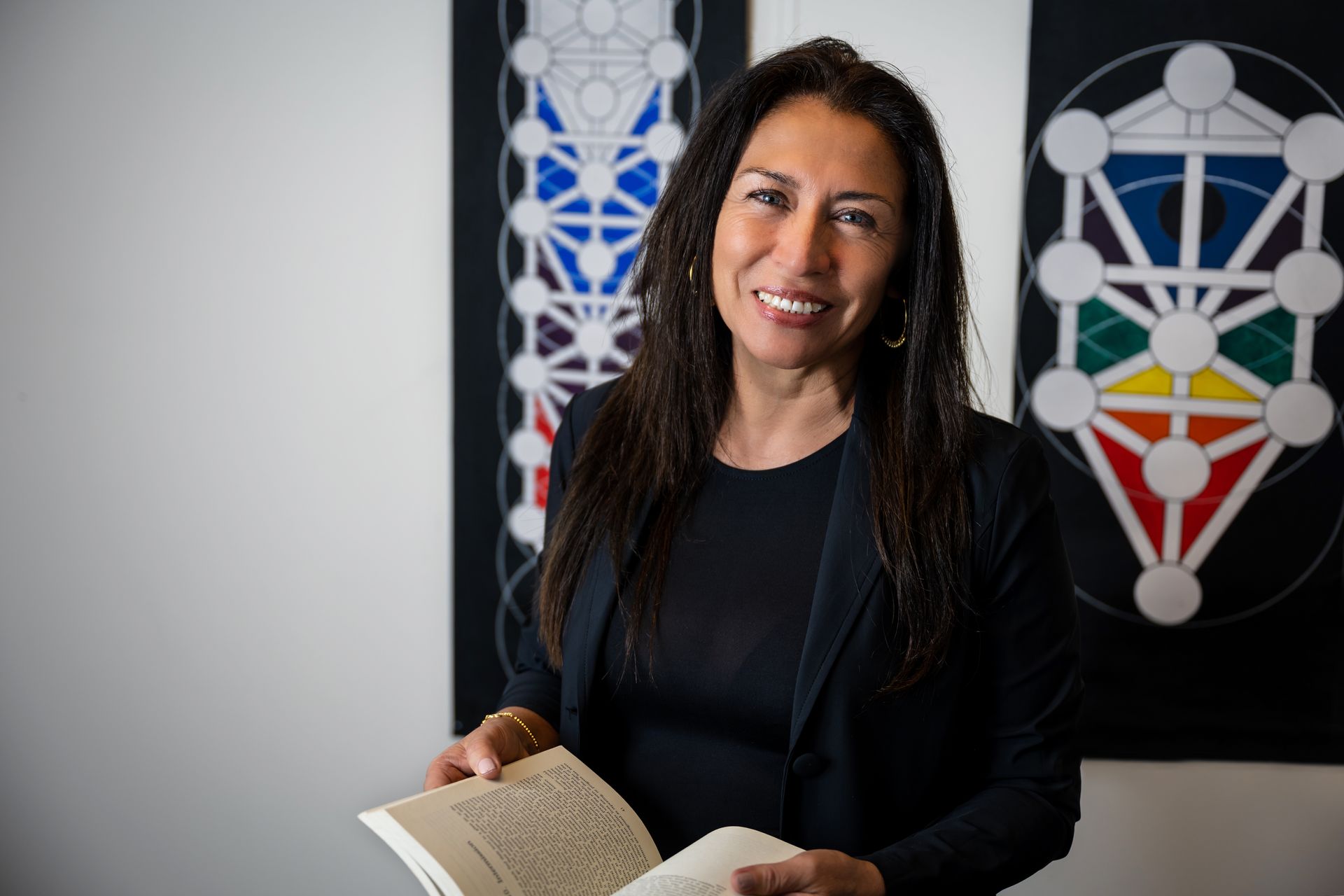
The Tree has ten sefirot, from Keter at the crown to Malkuth at the ground. Tree of Life meditation in Kabbalah means choosing one and staying with its quality. Malkuth for grounding, Tiferet for balance, Chesed for generosity. That is meditation on the sefirot at its simplest.
In my own work the same Tree is also a psychological map. It shows how energy moves from inspiration into form, where it tends to get stuck, and what a person needs to move again. You can read more about that in our Tree of Life work with Kabbalah.
Each letter is treated as a living shape. You look at it, trace it in the air, then close your eyes and keep its outline. Divine names and the names of the sefirot are repeated softly, almost under the breath. You do not need to read Hebrew. You need patience with a sound that stays the same.
The breath sets the pace and the image gives direction. On the inhale you might imagine light descending through the Tree, and on the exhale you let it settle into the body. This is the heart of Kabbalah breathwork, and our work on relaxation and breathwork uses the same slow rhythm. Kabbalistic visualisation techniques need no special talent, only a gentle pace.
Keep it short. A brief Jewish meditation such as the Shema takes only 5-10 minutes and can be done daily, and that is a sensible size for Kabbalah meditation too. Regular beats long, every time.
- Pick a fixed time, ideally before the house wakes up, and set a quiet timer for 5-10 minutes.
- Sit upright on a stable seat. Close your eyes, or rest them softly on one letter.
- Take six slow breaths and count them. Do not change anything else.
- Hold one object only: a letter, a name or one sefirah. When the mind wanders, and it will, return without scolding yourself.
- Finish by writing one sentence about what you noticed. Then stand up slowly.
Around 15% of adults meditate in countries that have measured it, so you are in large company. The difference here is the object you hold, and the map behind it.
The table below compares the entry points we suggest, so you can match one to how you feel today.
| Practice | What you hold | Time | Suits you when |
|---|---|---|---|
| Breath counting | Six slow breaths | 5 minutes | You are restless or new to sitting |
| Letter gazing | One Hebrew letter | 5-10 minutes | Your mind needs a visual anchor |
| Sefirah visualisation | One point on the Tree of Life | 10-15 minutes | You want direction in a life question |
| Guided meditation | A voice and an image | 15-20 minutes | You prefer being led |
| Hitbodeduth | Silence and solitude | 10-20 minutes | You already have a steady habit |
Most people start with breath counting for a week, then add a letter. Kabbalah guided meditation comes in once you want company in the practice.
- Chasing visions. Nothing needs to appear, and forcing images tires the mind.
- Jumping to letter permutations and chanting before the basics feel steady.
- Collecting techniques instead of repeating one.
- Sitting alone with heavy grief or trauma that begins to surface.
- Expecting calm on day three. It tends to arrive sideways, around week three.
Books, apps and videos are a fair way to taste the practice. What they cannot do is notice you. Kabbalah has always been passed on from person to person, and a teacher sees the moment a technique stops serving you.
I am a direct disciple of Z'ev ben Shimon Halevi at the Kabbalah School of the Soul in London, and of Mario Saban and Eduardo Madirolas at Cabala y Psicología in Barcelona. I have practised meditation since 2005 and taught Kabbalah since 2010. That lineage is what I bring into every session.
Seek guidance when strong emotions come up, during grief or a life transition, or when you feel an old wound stirring. My work is non-diagnostic and complementary. Where someone needs medical care, I refer them to their GP. As for cost, the price depends on session length, whether you meet in person or online, and whether you begin with one session or a course.
Many of our clients are expats, and they know that inner life speaks in the first language. Practise in the language where your feelings are most honest. I offer sessions in English and Spanish, so anyone searching for cabala meditación en español can work in their own tongue. Living between countries also shifts identity, and the Tree of Life gives that shift a place to land.
Some people cannot sit still, and some think too well to settle. For them we move first. Dance of the Soul™ is the embodied method I created and presented at the Eurotas conference at the University of Oxford in 2024. After movement the body is quieter, and a sitting opens more easily. Shamanic guided inner journeys follow the same logic, and you can read about it in Dance of the Soul.
A scent can mark the start of a sitting. When you use the same oil each morning, the body learns the signal and settles faster. We explain how that works in our guide to using essential oils in therapy, and how it pairs with a transpersonal approach, described in our transpersonal work.
Nearly every client I meet leaves with some form of meditation practice, because the work does not live in my consulting room. It lives in the twenty minutes you give yourself before the day begins. I have watched capable people understand themselves perfectly and change nothing for years. A daily sitting is where insight turns into something you can live. That is why we care so much about a small, steady habit, and why our guided meditations are built around it.
In the Netherlands, 57 percent of people aged 15 and older said in 2022 that they had no religious affiliation. So most Dutch people who try Kabbalah meditation do so outside any organised religion. Dutch Jews are among the most secularised Jewish communities in Europe, and only about 20% identify as Orthodox or Traditional. The core Jewish population is about 35,000 people, roughly 0.2% of the country, which is why teachers and courses are often found online or in a few big cities. Meanwhile about 15% of adults meditate, so the interest is mainstream.
© 2026 paolabobadilla.eu
"Kabbalah, and especially the Tree of Life, is one of the oldest and most precise psychological maps we have."
Meditation is how that map stops being theory, and we show how to walk the Tree of Life in practice, one sefirah at a time.
Are your invoices covered by health insurance?
It depends on each insurance policy, not on me. Check your policy for complementary care, and see our fees and conditions for how we invoice.
Do I need to be Jewish or religious to start?
No. You do not need to believe anything. Sceptics often do well here, because the practice asks for attention and honesty, not faith.
Which languages do you work in?
I work in English, Spanish and Dutch, in person in Den Haag or online with clients anywhere in the world.
Do you diagnose or replace medical care?
No. My approach is non-diagnostic and complementary. I am an accredited Holistic Alternative Practitioner under Dutch Wkkgz standards, and I refer severe cases to a GP.
What are the main techniques used in Kabbalistic meditation?
The main techniques are contemplating the sefirot on the Tree of Life, gazing at Hebrew letters, repeating divine names, and combining breath with visualisation. Silent solitude, known as Hitbodeduth, completes the set.
How does Kabbalistic meditation differ from other forms of meditation?
It works with a symbolic structure, the Tree of Life, letters and names, instead of only observing whatever arises. It also comes from a lineage passed from teacher to student.
What is the Tree of Life in Kabbalah meditation?
It is a diagram of ten sefirot describing how energy moves from inspiration into form. In meditation you rest on one sefirah at a time and feel its quality in the body.
Who was Abraham Abulafia and what were his meditation techniques?
Abulafia was a thirteenth-century Kabbalist who founded the ecstatic current. He combined Hebrew letters with breath, sound and movement of the head to reach heightened states.
What are divine names used for in Kabbalah meditation?
Divine names act as sound anchors. You repeat one softly, so attention stays on a single vibration and the mind gradually stops chasing thoughts.
How do you perform Hitbodeduth meditation?
Find a quiet place, sit alone and turn inward, either in silence or in plain inner speech. Start with 10 minutes and let whatever is true come up without editing it.
What is Merkavah meditation in Kabbalah?
It is an early visionary practice based on Ezekiel's chariot vision, where the practitioner imagines an inner ascent through stages. It is a historical root, so a guide is advisable.
What are the benefits of practising Kabbalistic meditation?
Practitioners commonly report calm, clearer self-knowledge and a stronger sense of meaning. These are personal experiences, not medical outcomes, and results vary with regular practice.
What is the role of Hebrew letters in Kabbalah meditation?
Letters are treated as living forms. You gaze at one, trace it and keep its image inwardly, which gives the mind a steady visual anchor.
How do visualisation and breathing work together in Kabbalah meditation?
The breath sets a slow rhythm and the image gives it direction. You might imagine light descending on the inhale and settling into the body on the exhale.
Call us on +31648482097 and we will talk through where you are and which sitting suits you. We usually begin with a single conversation, no commitment. If you prefer writing, send us a message and we will reply.
At Holistic Psychology Practice you can read who we are, explore our holistic therapy, or go straight to therapeutic meditation. Our art, play and dance work suits those who think best through the body. We see clients in The Hague and offer an English-speaking practice for expats. When you are ready to begin, call +31648482097 or contact us to book your first conversation.
Share This Blog